Written by Yad Singh, Fencing Specialist at Top Class Fences & Gates — 10 years’ experience supplying pool fencing across Brisbane. Top Class Fences has served Brisbane & QLD since 1982. Published 26 June 2026 · Last updated 26 June 2026.
Buying a new pool fence in Queensland? Before you spend a dollar, here’s exactly what your barrier must do to pass inspection first time. In Queensland, a pool barrier must be at least 1200 mm (1.2 m) high, have a gap of no more than 100 mm at the bottom, keep all climbable objects at least 900 mm away (the non-climbable zone), and use a gate that self-closes and self-latches every time. Rules are set by the Queensland Development Code MP 3.4 and Australian Standard AS 1926.1-2012, and your pool fence must be certified by a pool safety inspector before you fill the pool.
Before you buy: 60-second compliance checklist
Use this when comparing panels and quotes — if a product fails any line, it can’t pass inspection:
- Panels at least 1200 mm high once installed
- Vertical bars no more than 100 mm apart (and no more than 100 mm ground gap)
- Panels tested to AS 1926.1 — look for NATA-approved certification (all our pool panels are)
- A self-closing, self-latching gate that opens away from the pool, latch 1600 mm above ground
- Nothing climbable within the 900 mm non-climbable zone (plan your BBQ, pots and trees now, not after)
- Booked: a licensed pool safety inspector to certify the finished barrier
👉 Shop NATA-approved pool fencing » · New here? See types & costs first »
Quick-reference: Queensland pool fence requirements
| Requirement | The rule |
|---|---|
| Minimum height | At least 1200 mm (finished ground level to top of fence) |
| Gap at the bottom | Maximum 100 mm from the ground to the bottom of the barrier |
| Gaps between vertical bars | Max 100 mm apart (if horizontal rails are 900 mm+ apart) |
| Non-climbable zone (NCZ) | No climbable objects within 900 mm of the barrier |
| Maximum height | No higher than 2 m; if over 2 m, not within 1.5 m of a boundary |
| Gates | Must self-close and self-latch from any position; never propped open |
| Windows into the pool area | Must not open more than 100 mm (or be screened/restricted) |
| Certification | A pool safety inspector must approve it before you fill the pool |
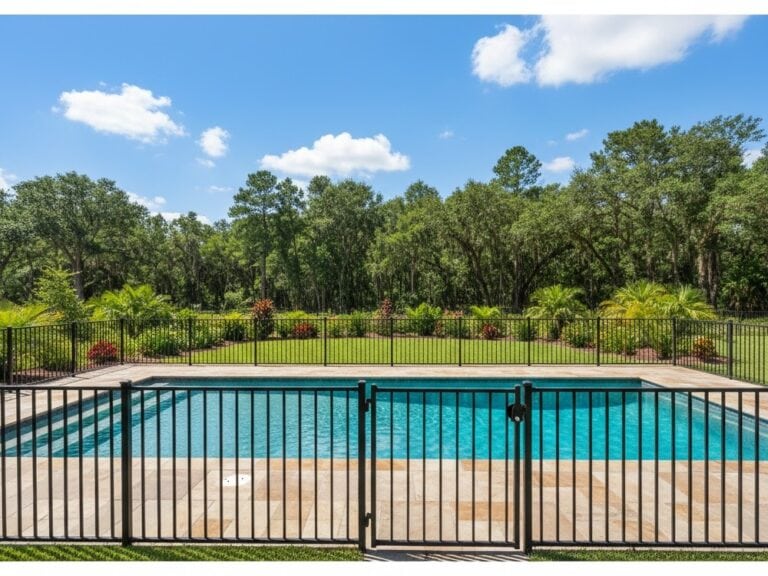
How high does a pool fence need to be in QLD?
Your pool barrier must be at least 1200 mm (1.2 metres) high, measured from the finished ground level to the top of the fence. It also can’t be higher than 2 metres — and if it is over 2 m, it can’t sit within 1.5 m of a property boundary.
What are the gap rules?
Two gaps matter:
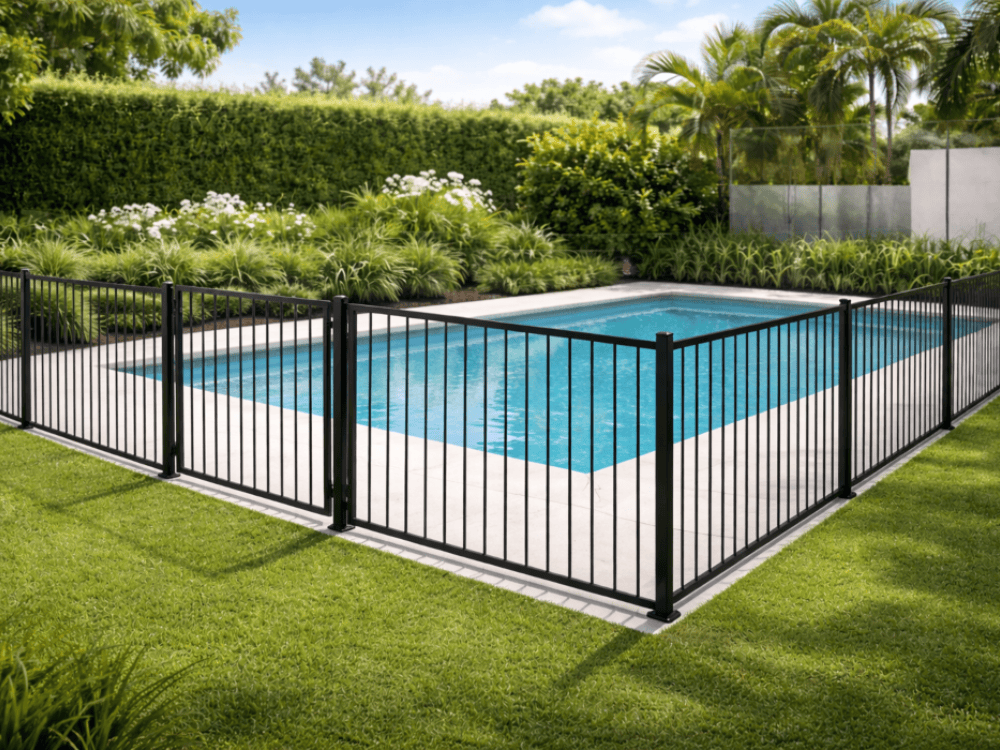
- Bottom gap: no more than 100 mm between the ground and the bottom of the fence — so a small child can’t crawl under.
- Between vertical bars: if your horizontal rails are 900 mm or more apart, the vertical bars/slats can be up to 100 mm apart. If the rails are closer than 900 mm, the gaps must be under 10 mm.
What is the “non-climbable zone” (NCZ)?
Young children climb. The non-climbable zone means there must be no footholds within 900 mm of the pool barrier — on either side. That includes:
- Trees, pot plants, BBQs, pool pumps, chairs and tables
- Horizontal rails on an adjoining boundary fence that a child could use like a ladder
Keeping this 900 mm zone clear is one of the most common reasons pools fail inspection.
What are the gate requirements?
The gate is the highest-risk part of any pool fence. It must:
- Self-close from any open position — without being pushed
- Self-latch securely every time
- Open outward, away from the pool
- Have the latch positioned out of young children’s reach (confirm the exact latch height with your certifier)
- Never be propped open
Do I need approval for a pool fence in Brisbane?
Yes — a pool safety certificate is required. You must use a licensed pool safety inspector, and importantly: you can’t fill your pool with water until the certifier confirms the barrier complies. You do not need separate planning approval. Brisbane City Council also carries out pool safety inspections and can issue on-the-spot fines for non-compliance.
Which standard applies to my pool?
Queensland pool barriers are governed by the Queensland Development Code MP 3.4 and Australian Standard AS 1926.1-2012 (for pools built/altered since late 2010). Older pools may fall under earlier versions — your certifier will confirm which applies to you.
Frequently asked questions
How high does a pool fence have to be in Queensland?
At least 1200 mm (1.2 m) from the finished ground to the top of the fence, and no more than 2 m high.
What is the maximum gap under a pool fence in QLD?
100 mm between the ground and the bottom of the barrier.
Do pool fences need a self-closing gate in Queensland?
Yes. The gate must self-close and self-latch from any position and must never be propped open.
How far must objects be from a pool fence?
At least 900 mm — the non-climbable zone. No climbable objects (plants, furniture, pumps) within that distance.
Do I need council approval for a pool fence in Brisbane?
You need a pool safety certificate from a licensed pool safety inspector, and the pool can’t be filled until it’s certified. No separate planning approval is required.
Is a CPR sign required?
Queensland requires a current CPR (resuscitation) sign displayed near the pool — check the latest requirement with your certifier.
Important disclaimer
This guide is general information to help you understand Queensland’s pool fencing rules — it is not legal advice, and requirements can change or vary with your pool’s age and site. Always confirm compliance with a licensed QLD pool safety inspector or pool safety inspector before relying on it.
Need a compliant pool fence?
Top Class Fences supplies QLD-compliant pool fencing — glass, aluminium and steel pool fence panels, gates, posts and hardware that meet the standard. Shop pool fencing supplies » or get a free quote ». Supplying Brisbane & QLD since 1982.
Sources: QBCC — Pool fences · Queensland Government — Fences and barriers · Brisbane City Council — Pool fence