Choosing the wrong timber for your fence is an expensive mistake. Pick a species that can’t handle the Queensland climate and you’ll be replacing boards, re-setting posts, or rebuilding entire sections within just a few years.
The good news is that once you understand what each timber type offers, the decision becomes straightforward. In this guide, we compare every major timber option used for fencing in Australia — covering durability, cost, maintenance, and which timber is right for each part of your fence.
Quick Answer: What Is the Best Timber for Fencing in Australia?
There’s no single “best” timber — it depends on which part of the fence you’re building:
| Fence Component | Best Timber Choice | Runner-Up |
|---|---|---|
| Fence posts (in-ground) | Hardwood (H4 treated) | H4 treated pine |
| Fence rails | Treated pine (H3) | Hardwood |
| Fence palings | Treated pine (H3) | Hardwood palings |
| Picket fences | Treated pine (H3) | Cypress pine |
| Premium / feature fences | Hardwood (Merbau, Spotted Gum) | Treated pine |
| Acreage / rural fencing | Hardwood posts | Cypress pine rails |
The most popular and cost-effective approach for Australian homes is to combine both — hardwood posts in the ground and treated pine palings and rails above ground. This gives you the durability where you need it most, at a price that makes sense.
Timber Option 1: Treated Pine
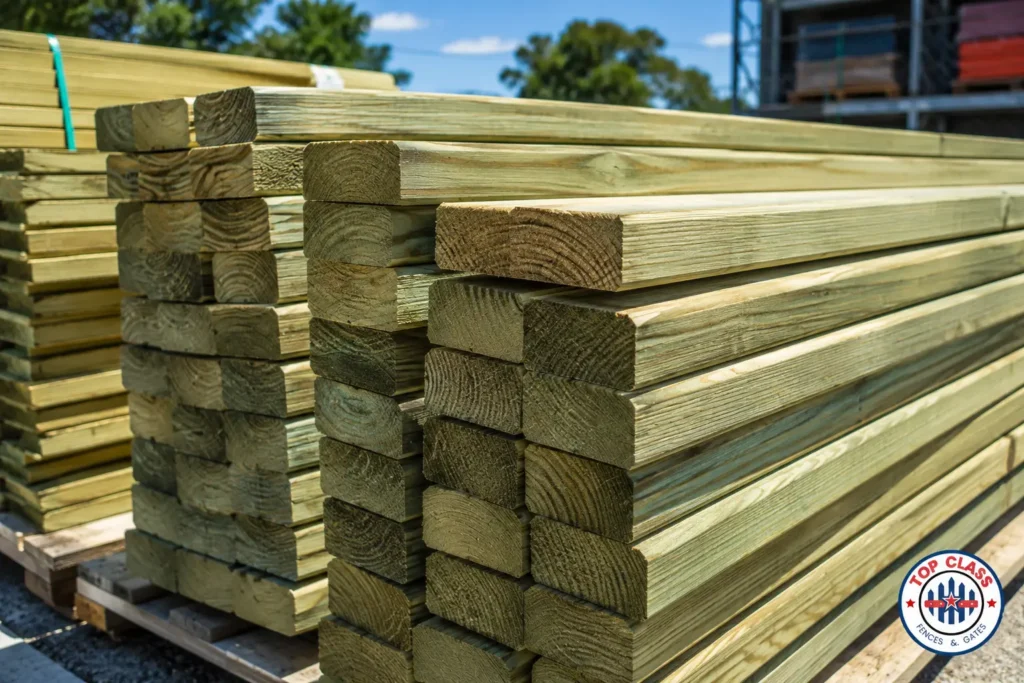
Treated pine is Australia’s most widely used fencing timber — and for good reason. It’s affordable, readily available, and when correctly treated, performs well in all Australian climates.
How it’s treated
Raw pine rots quickly when exposed to weather. To make it suitable for outdoor fencing, it’s pressure-treated with chemical preservatives to create resistance to rot, decay and termite attack. Treatment levels are graded by hazard class:
- H3 — above-ground use, exposed to weather. Used for palings and rails.
- H4 — in-ground use. Used for fence posts where timber contacts soil.
Always confirm the treatment level before buying. Using H3 timber in the ground — one of the most common DIY mistakes — leads to premature rot and fence failure within a few years.
Pros
- Most affordable option for palings and rails
- Widely available across Queensland
- Easy to cut, nail and work with
- Can be painted or stained any colour
- H3 treatment makes it suitable for all above-ground fence components
Cons
- Being a softwood, it’s prone to shrinking, warping, and splitting as it dries out — especially in Queensland’s heat
- Requires staining or painting every 3–5 years to maintain appearance and protection
- Less premium-looking than hardwood
Best for
Palings, rails, and picket fences where budget is a priority. Our treated pine palings and treated pine rails are H3 treated and ready to install.
Timber Option 2: Hardwood
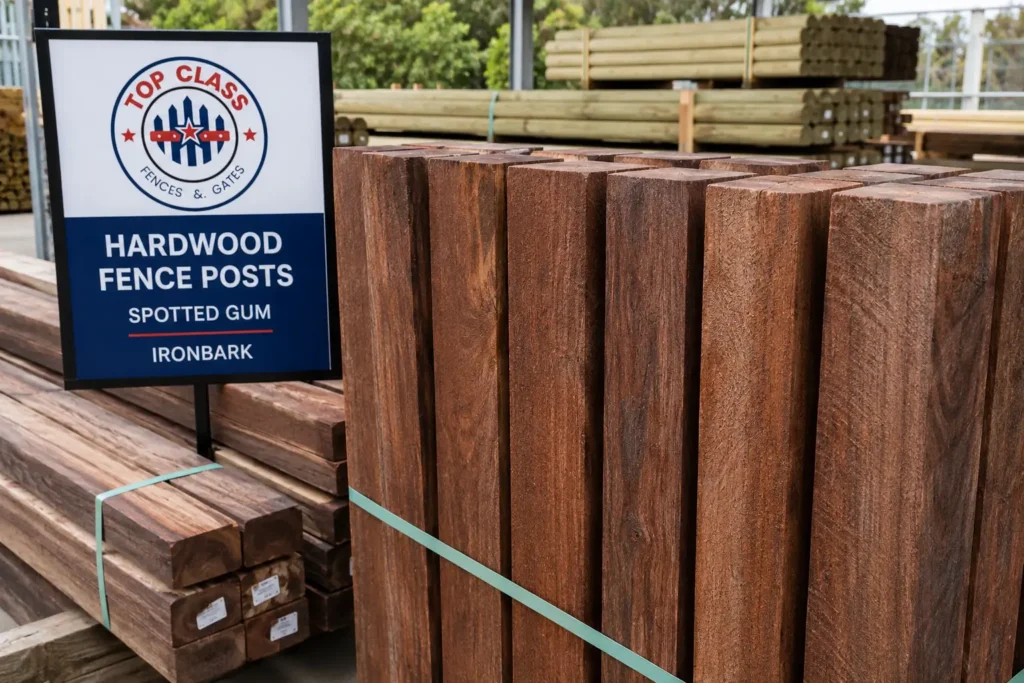
Hardwood timbers — species like Spotted Gum, Ironbark, Merbau, Blackbutt, and Tallowwood — are the premium choice for Australian fencing. They’re denser, stronger, and naturally more durable than pine.
Natural durability
Unlike treated pine, premium Class 1 and Class 2 hardwoods don’t rely entirely on chemical treatments to resist decay and insects. Their natural density and oils make them inherently resistant to termites, borers, and fungal rot — properties that are particularly valuable in Queensland’s termite-prone areas.
Durability class explained
Australian hardwoods used for fencing are rated by natural durability class:
- Class 1 — Ironbark, Spotted Gum, Tallowwood. Extremely durable, 25+ years in-ground life.
- Class 2 — Blackbutt, Merbau. Very durable, 15–25 years in-ground.
A Class 1 hardwood post set in the ground can outlast a treated pine post by decades.
Pros
- Superior natural durability — especially for fence posts
- Naturally resistant to termites and decay
- Premium appearance with rich natural grain
- Less maintenance required over time
- Stronger and more structurally sound than pine
Cons
- Significantly more expensive than treated pine
- Heavier and harder to work with — often needs pre-drilling
- Limited colour customisation compared to pine (stain and oil rather than paint)
Best for
Fence posts (always), rails on premium builds, full hardwood feature fences, and properties in high-moisture or coastal Queensland areas where durability is the priority.
Timber Option 3: Cypress Pine
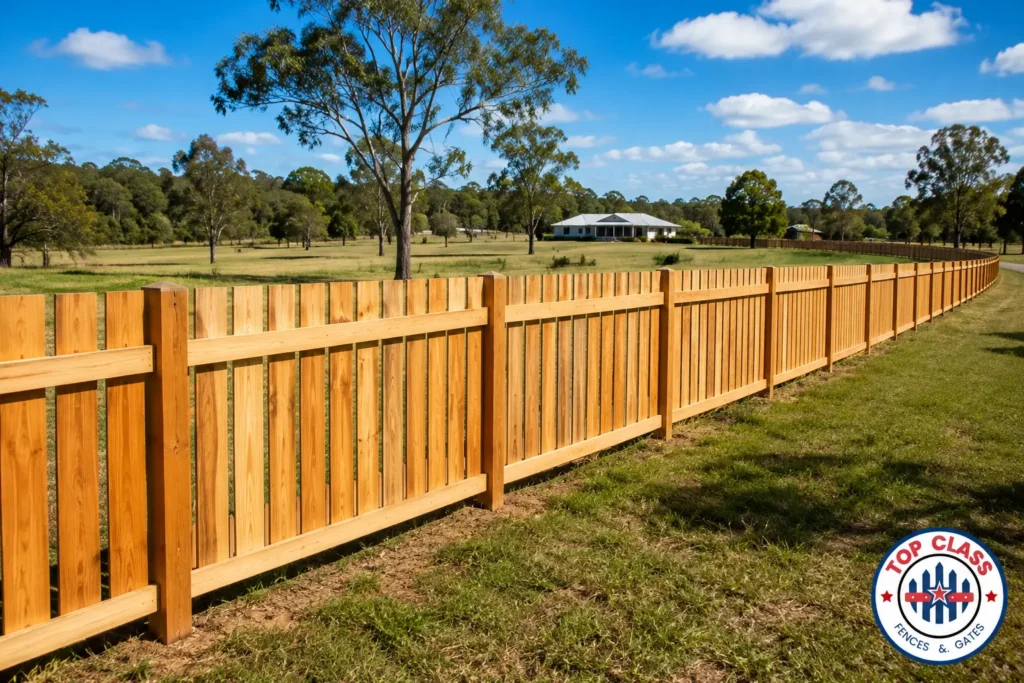
Cypress pine is a native Australian softwood that sits between treated pine and hardwood in terms of cost and durability. It’s naturally resistant to termites and decay due to its natural oils, without requiring the heavy chemical treatments that treated pine needs.
Pros
- Naturally termite-resistant — a major advantage in Queensland
- More affordable than hardwood
- Attractive, distinctive grain pattern
- Good dimensional stability — less warping than treated pine
Cons
- Prone to splitting when nailing — always pre-drill
- Significant colour variation between boards
- Less commonly stocked than treated pine — harder to source
- Not quite as strong as hardwood for structural posts
Best for
Rural and acreage properties where natural termite resistance is important and a premium hardwood budget isn’t available. Also popular for picket and decorative fences in regional Queensland.
Timber Option 4: Merbau
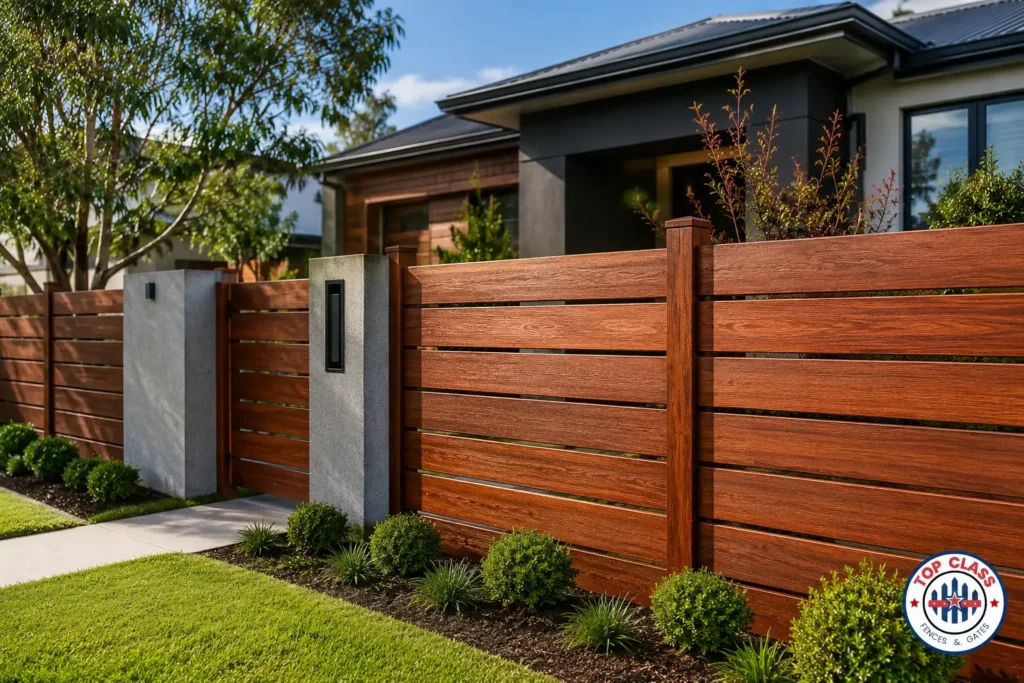
Merbau deserves a special mention as one of the most popular hardwood species used for Australian residential fencing. It offers a rich reddish-brown colour, excellent durability, and strong natural resistance to insects and weathering.
Pros
- Beautiful, consistent warm-toned grain
- Naturally durable Class 2 hardwood
- Resistant to decay, insects, and weathering
- Ages gracefully — develops a silver patina over time if left unsealed
Cons
- More expensive than treated pine
- Can bleed tannins onto nearby surfaces (driveways, garden beds) when first installed if not sealed
- Heavier than treated pine
Best for
Premium residential privacy fences, front boundary fences, and any application where appearance is as important as durability.
Which Timber Is Best for Fence Posts?
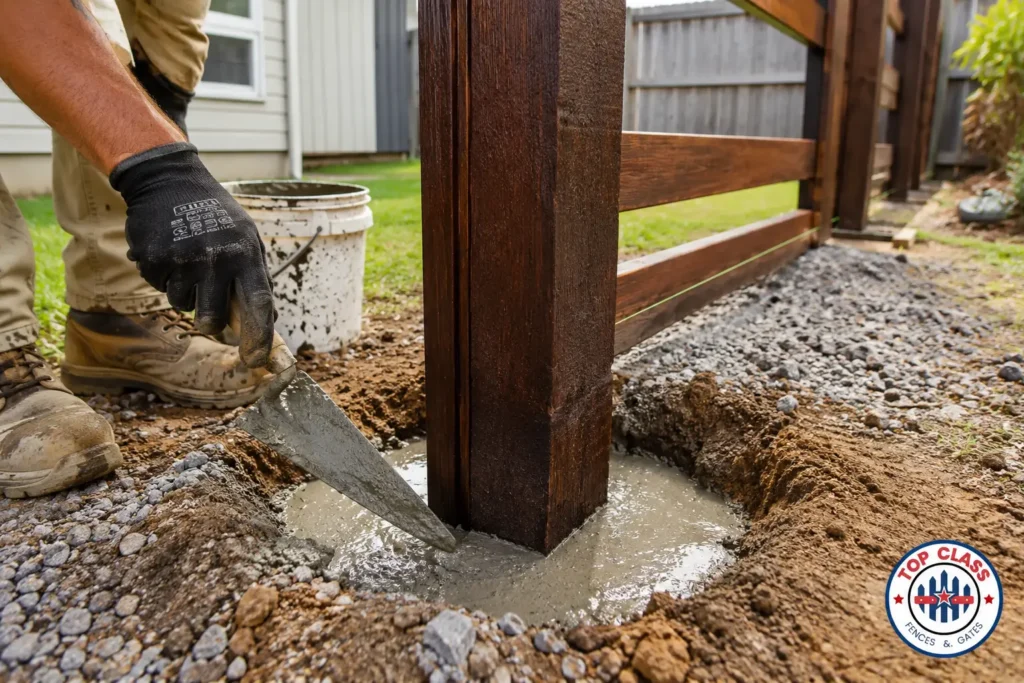
This is the most critical decision in any fence build. Fence posts are set in the ground and bear the structural load of the entire fence — if your posts fail, the whole fence fails.
Always use H4-treated timber or Class 1–2 hardwood for fence posts.
Here’s how the options compare for in-ground posts specifically:
| Post Timber | In-Ground Durability | Cost | Termite Resistance |
|---|---|---|---|
| Class 1 Hardwood (Ironbark, Spotted Gum) | 25+ years | $$$ | Excellent (natural) |
| Class 2 Hardwood (Merbau, Blackbutt) | 15–25 years | $$ | Very good (natural) |
| H4 Treated Pine | 10–15 years | $ | Good (chemical) |
| Cypress Pine | 10–20 years | $$ | Good (natural oils) |
For Queensland’s climate — with its combination of heat, humidity, and termite pressure — hardwood posts are the preferred choice for any fence expected to last 20+ years.
Which Timber Is Best for Fence Palings?
For above-ground palings, the equation changes. Cost becomes more important because palings make up the bulk of your material quantity, and they’re not exposed to the same in-ground decay risks as posts.
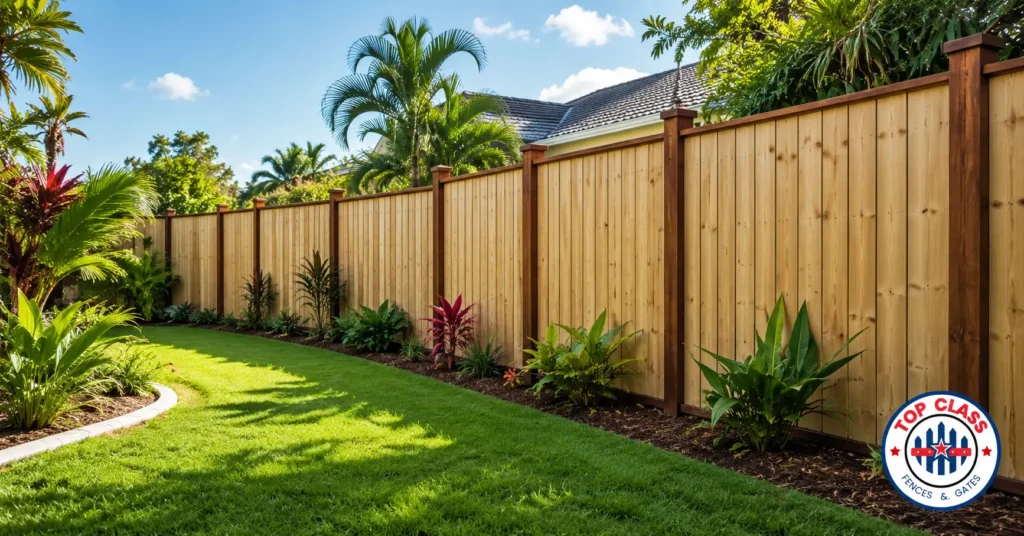
H3 treated pine is the go-to choice for palings across Australia for most residential applications. It strikes the right balance between cost, availability, and performance when correctly installed and maintained.
If budget allows or you’re building a high-end feature fence, hardwood palings deliver a premium finish with better natural durability and less maintenance over time.
Best Timber for Fencing in Queensland Specifically
Queensland’s climate adds extra considerations that don’t apply in cooler southern states:
- Termite pressure is higher — use naturally resistant timbers (hardwood, cypress) or H4-treated timber for all in-ground components
- UV exposure is intense — all timber needs a quality UV-resistant stain or paint to prevent surface cracking and breakdown
- Humidity and moisture — correct H3/H4 treatment selection is essential; untreated or under-treated timber will fail much faster in subtropical conditions
- Temperature fluctuations — timber expands and contracts with temperature swings. Hardwood handles this better than pine due to its density
For Queensland homes, the recommended combination is H4 hardwood posts + H3 treated pine palings and rails — giving you termite-resistant structural posts where it matters most, combined with cost-effective above-ground components.
Cost Comparison: Timber Types Side by Side
| Timber Type | Relative Cost | Lifespan (above ground) | Lifespan (in-ground) | Maintenance |
|---|---|---|---|---|
| Treated pine (H3/H4) | $ | 20–25 years | 10–15 years | Every 3–5 years |
| Cypress pine | $$ | 20–30 years | 15–20 years | Every 5–7 years |
| Merbau (Class 2 hardwood) | $$ | 25–30 years | 15–25 years | Every 5–7 years |
| Ironbark / Spotted Gum (Class 1) | $$$ | 30+ years | 25+ years | Every 7–10 years |
For a full breakdown of what each option costs per metre installed, see our timber fencing cost guide for Australia.
Our Recommendation for Most Australian Homeowners
For the best combination of value, durability, and performance in Queensland’s climate:
- Posts — H4 hardwood (Spotted Gum, Ironbark or similar Class 1–2 species)
- Rails — H3 treated pine (cost-effective and more than adequate above ground)
- Palings — H3 treated pine Colonial Top or Flat Top
- Finish — Quality exterior stain or paint applied within 3 months of installation
This combination gives you a fence built to last 25+ years in Queensland’s conditions without overspending on full-hardwood construction.
Frequently Asked Questions
Q1. What is the most durable timber for fencing in Australia?
Ans. Class 1 hardwoods like Ironbark and Spotted Gum are the most durable, offering 25+ years of in-ground life and exceptional natural resistance to termites and decay. For above-ground components, Class 2 hardwoods like Merbau and Blackbutt are an excellent choice.
Q2. Is treated pine good enough for fence posts in Queensland?
Ans. H4 treated pine is suitable for fence posts, but in Queensland’s termite-prone environment it typically lasts around 10 years in-ground. Hardwood posts in the same conditions and exposure will last 20 to 25 years — making hardwood the significantly stronger and longer-lasting choice when comparing like for like.
For a fence expected to last 25+ years, hardwood posts (Spotted Gum or Ironbark) are the better long-term investment. If budget is the priority, H4 treated pine is a workable option, but factor in the likelihood of needing to replace posts within a decade.
Q3. What’s the best timber for a privacy fence in Australia?
Ans. For a residential privacy fence, treated pine palings on hardwood posts delivers the best balance of cost and durability. If you want a premium look, full hardwood palings in Merbau or Spotted Gum are the top choice.
Q4. Does timber fencing suit Queensland’s climate?
Ans. Yes — when the right species and treatment levels are used. H3/H4 treated timber and naturally durable hardwoods are both well-suited to Queensland’s subtropical climate. The key is using the right timber for each component (posts vs palings) and applying a quality UV-protective finish.
Q5. What is the difference between H3 and H4 treated pine for fencing?
Ans. H3 treated pine is suitable for above-ground use exposed to weather — used for fence palings and rails. H4 treated pine is required for in-ground use where timber contacts soil — always use H4 for fence posts. Using H3 timber in the ground is one of the most common DIY fencing mistakes and leads to premature rot and fence failure.
Q6. How long does hardwood fencing last in Australia?
Ans. Class 1 hardwoods like Ironbark and Spotted Gum can last 25+ years in-ground and 30+ years above ground. Class 2 hardwoods like Merbau and Blackbutt typically last 15–25 years in-ground and 25–30 years above ground, with maintenance every 5–7 years.
Q7. Is Merbau good for fencing in Australia?
Ans. Yes. Merbau is one of the most popular hardwood species for Australian residential fencing. It offers a rich reddish-brown grain, Class 2 natural durability, and strong resistance to decay, insects and weathering — making it an excellent choice for premium privacy and boundary fences.
Q8. What is the best timber combination for fencing in Queensland?
Ans. The recommended combination for Queensland homes is H4 hardwood posts (Spotted Gum or Ironbark) with H3 treated pine palings and rails above ground. This gives you termite-resistant structural posts where it matters most, combined with cost-effective above-ground components — ideal for Queensland’s subtropical climate.
Q9. Difference between hardwood and treated pine sleeper, which lasts longer?
Ans. Hardwood and treated pine timber are two different qualities of the timber both are treated. Hardwood is considered to be more strong as compare to treated pine. Treated pine is considered to be as lightweight material providing structure more stability in term of normal weight.
Q10. Difference between hardwood and treated pine sleeper, which lasts longer?
Ans. Hardwood and treated pine timber are two different qualities of the timber both are treated. Hardwood is considered to be more strong as compare to treated pine. Treated pine is considered to be as lightweight material providing structure more stability in term of normal weight.
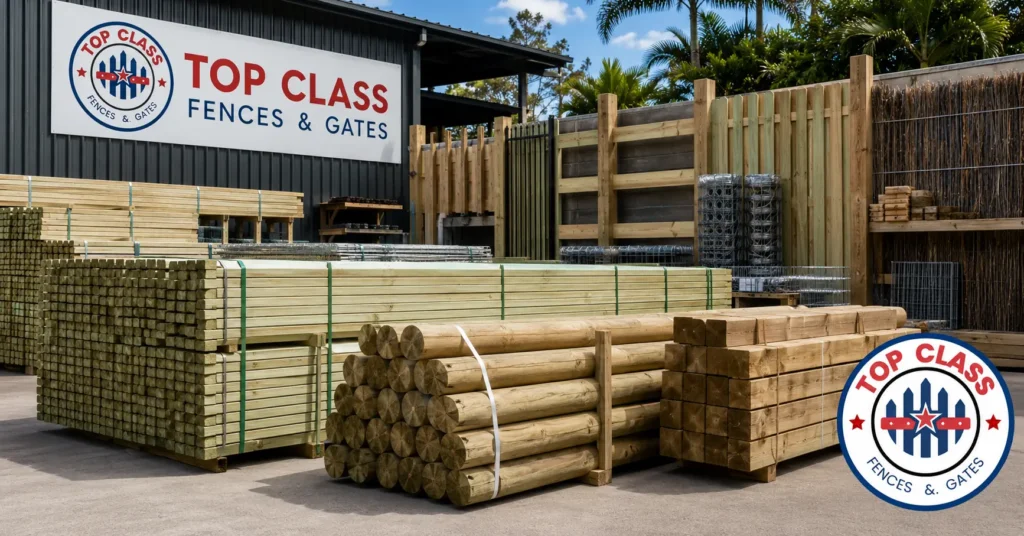
Shop Timber Fencing Supplies at Top Class Fences
Top Class Fences stocks a full range of treated pine and hardwood fencing products — H3 treated palings, H4 treated posts, fence rails, and sleepers — all labelled by treatment class so you always get the right product for the job.
Browse our full timber fencing range →
Not sure what you need? Call us on 0415 467 185 and our team will help you spec out exactly the right timber for your project.
Related guides
Planning a timber fence? See how much timber fencing costs and the benefits of a timber fence.