If you’re planning a sleeper retaining wall, you’ll hit the same fork in the road as every Australian homeowner, landscaper and builder before you: timber or concrete? Both materials build excellent walls. Both have passionate advocates. And both can be the wrong choice if they’re matched to the wrong project.
This guide breaks down the real-world differences between a timber sleeper retaining wall and a concrete sleeper retaining wall — actual costs in Australian dollars, honest lifespan figures, installation requirements, council approval rules, and a straightforward decision framework.
The 30-Second Answer
| Timber Sleepers | Concrete Sleepers | |
|---|---|---|
| Upfront cost | Cheaper | 30–60% more |
| Lifespan | 15–25 years | 50+ years |
| Maintenance | Ongoing | Virtually none |
| DIY-friendly | Yes | Low walls only |
| Termites, rot, fire | Vulnerable | Immune |
| Best for | Low garden walls, raised beds, budget builds | Structural, engineered & long-term walls |
Verdict: Concrete wins on long-term value for structural walls. Timber wins on price, DIY ease and natural warmth for low garden walls. Details below.
What Are Sleepers in Construction?
The term comes from the railways. Original railway sleepers were the heavy hardwood beams laid beneath train tracks, and when decommissioned lines were pulled up, those salvaged beams found a second life holding back soil in Australian gardens. The name stuck.
Today, “sleeper” simply describes any long, rectangular beam — timber or concrete — used horizontally in landscaping and retaining structures. Modern concrete railway sleepers used in landscaping aren’t actually salvaged from rail lines; they’re purpose-made, steel-reinforced concrete panels manufactured to slot between posts. Likewise, most timber sleepers sold today are new treated pine or hardwood rather than recycled track timber, though genuine recycled railway sleepers are still available for rustic projects.
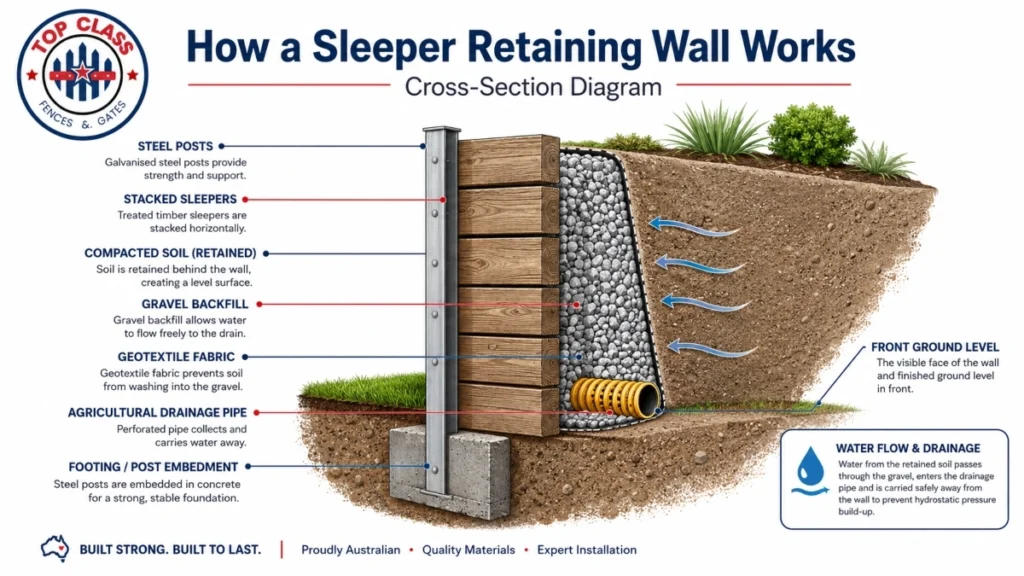
In a sleeper retaining wall, the sleepers stack horizontally between vertical posts (galvanised steel H-beams or C-channels for concrete; timber or steel posts for wood) that are concreted into the ground. The posts carry the load; the sleepers hold back the earth.
Timber Sleeper Retaining Walls: Strengths and Weaknesses
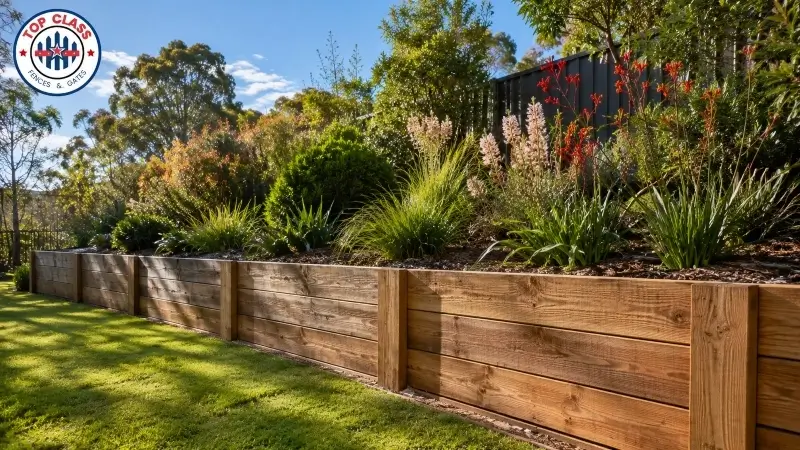
Timber sleepers remain the most popular entry point for Australian DIYers, and for good reason.
Where Timber Wins
| Advantage | Why It Matters |
|---|---|
| Upfront cost | Treated pine sleepers run $20–$50 each; hardwood sleepers $40–$90. A small garden wall can cost half the equivalent concrete build. |
| Workability | A 200 × 75mm pine sleeper weighs 20–30kg — one person can carry, cut and drill it with standard tools. Genuine weekend-DIY territory. |
| Natural aesthetics | Real grain, real warmth. Perfect for cottage gardens, bushland blocks and native landscaping. Weathers to a beautiful silver-grey. |
| Easy modification | Need a step, a shorter run, or a notch around a pipe? Timber forgives. Concrete doesn’t. |
Where Timber Struggles
| Drawback | The Reality |
|---|---|
| Lifespan | H4 treated pine: 15–20 years in ground contact. Hardwood: 20–25 years. Wet, poorly drained or termite-prone sites: often less. |
| Maintenance | Periodic inspection for rot, splitting and termites, plus resealing to hold the look. Soil-side decay hides until the wall leans. |
| Movement | Timber swells, shrinks and twists with moisture cycles. Gaps open, soil weeps through, crisp lines fade. |
| Termites | H4 treatment dramatically reduces risk — but cut ends that aren’t resealed remain an open door. |
Pro tip: If you go timber, insist on H4 treatment minimum for any in-ground retaining use. H3 is for above-ground only — it will fail early in a retaining wall.
Concrete Sleeper Retaining Walls: Strengths and Weaknesses
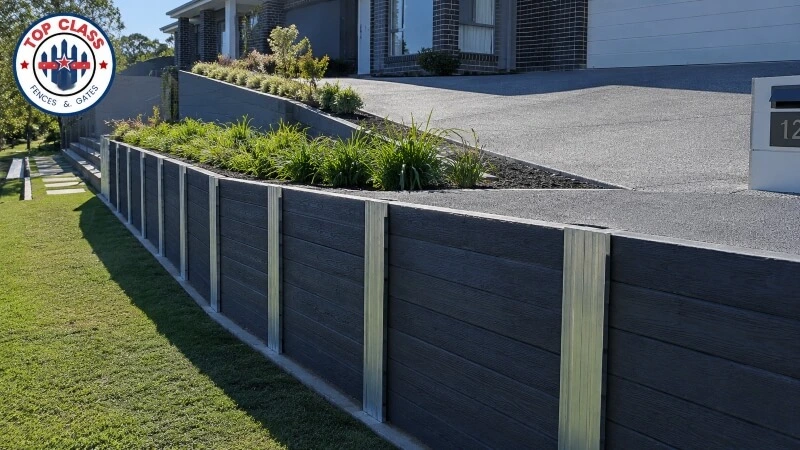
Concrete sleepers have surged over the past decade, and in many Australian markets — particularly South East Queensland — retaining wall concrete sleepers now outsell timber for structural walls.
Where Concrete Wins
| Advantage | Why It Matters |
|---|---|
| Lifespan | Steel-reinforced sleepers rated 50+ years, with structural warranties of 15–30 years common. No rot, no termites, no fire risk. |
| Zero maintenance | No sealing, no oiling, no inspections. For rentals and commercial sites, maintenance is a cost line that simply disappears. |
| Structural capacity | Paired with galvanised steel posts, concrete handles tall walls and surcharge loads (driveways, pools, sheds) far beyond timber. |
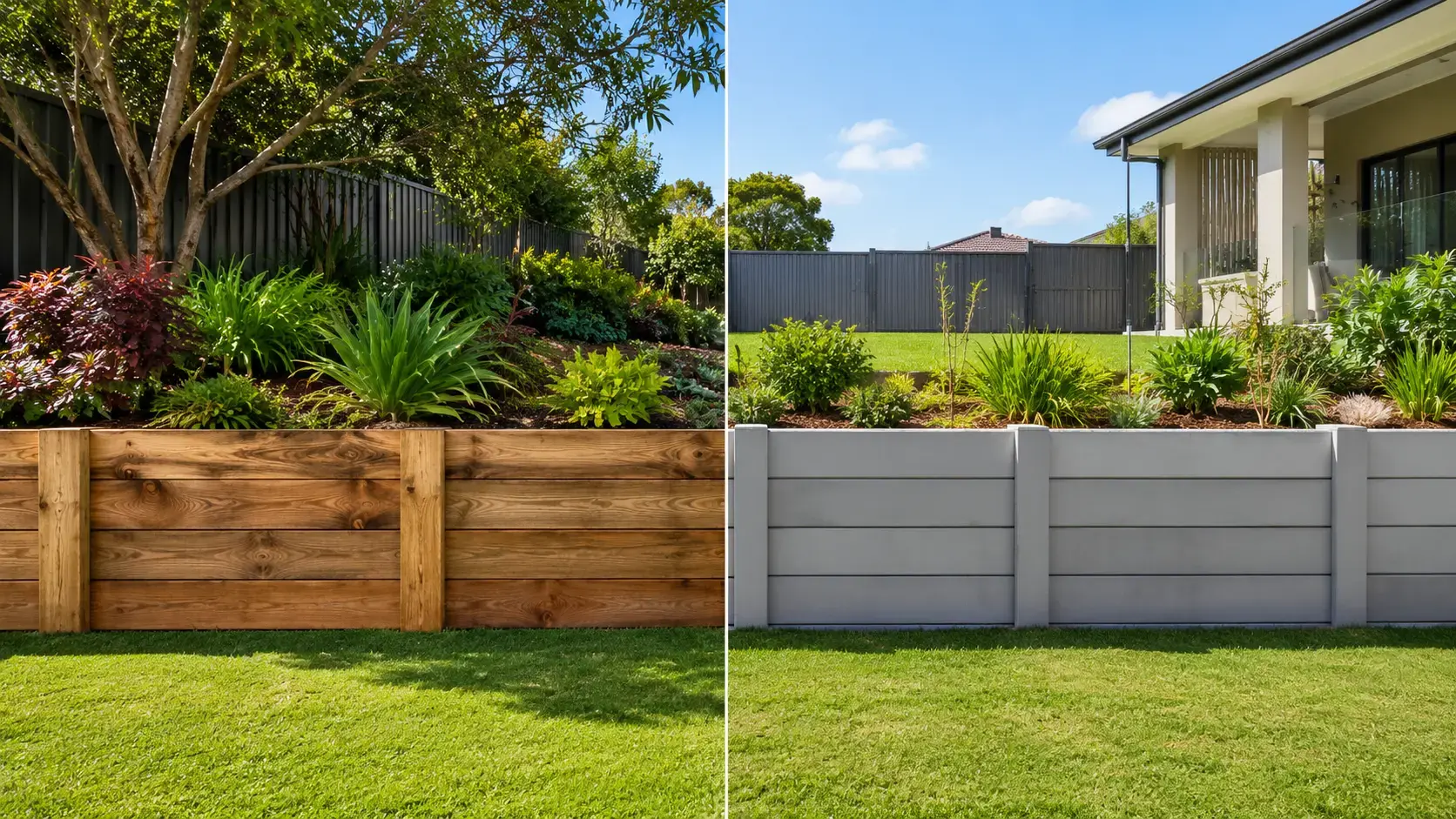
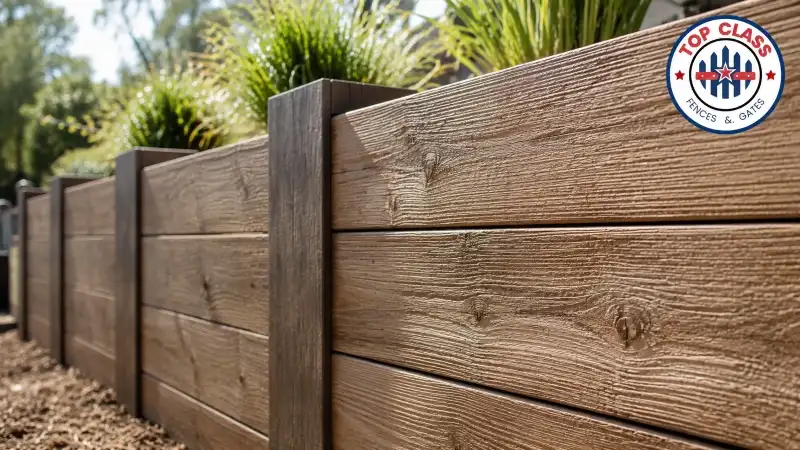
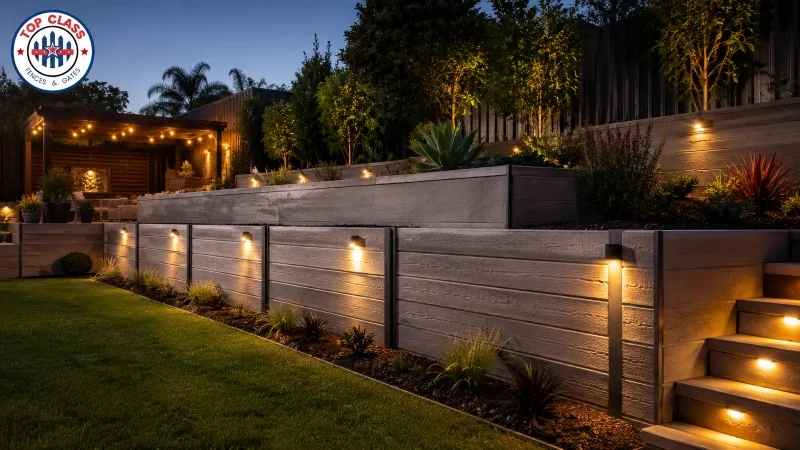
| Design range | Smooth grey, charcoal, sandstone, stackstone — and woodgrain finishes cast from real timber moulds for the timber look without the decay. |
Where Concrete Struggles
| Drawback | The Reality |
|---|---|
| Upfront cost | $70–$120+ per 2.0m sleeper, plus $50–$150 per steel post. Materials run 30–60% above timber. |
| Weight | A standard 2.0m sleeper weighs 75–85kg. Two-person lift minimum; machinery for taller walls. Pushes most projects to pros. |
| Unforgiving set-out | Sleepers can’t be trimmed on site without compromising reinforcement. Post centres must be precise, or you’re reordering. |
| Quality variance | Cheap, poorly cured sleepers chip and hairline-crack. Supplier reputation matters more with concrete than timber. |
Cost Comparison: How Much Are Concrete Sleepers vs Timber?
Indicative 2026 supply-only pricing across Australia:
| Item | Timber (Treated Pine) | Timber (Hardwood) | Concrete |
|---|---|---|---|
| Sleeper, 2.0m × 200mm | $25–$50 | $45–$90 | $70–$120 |
| Posts (each) | $25–$60 | $40–$80 | $50–$150 (galv. steel) |
| Installed wall, per m² | $250–$450 | $350–$550 | $400–$700 |
Common stocked sizes sit at the heart of these ranges — for example 200×75 treated pine, 200×50 hardwood and 200×50×2350 concrete sleepers — so it pays to price your exact wall before assuming either material is out of budget.
But the picture flips over a 50-year horizon:
| 50-Year Scenario | Treated Pine | Concrete |
|---|---|---|
| Initial build (10m² wall) | ~$3,500 | ~$5,500 |
| Rebuilds needed | 1–2 | 0 |
| Maintenance | Sealing, repairs | Nil |
| Realistic 50-year total | $8,000–$12,000+ | ~$5,500 |
| Cost per year of service | $160–$240 | ~$110 |
The bottom line: For walls you’ll keep for decades, concrete is usually the cheaper material per year of service — the higher price simply arrives upfront. For short-horizon projects (a rental tidy-up, a property you’re selling in five years), timber’s lower entry price wins.
Lifespan: How Long Do Concrete Sleepers Last?
Properly manufactured and installed, concrete sleepers last 50 years or more — there’s no biological mechanism for them to fail. Degradation only occurs through physical damage or, over very long periods, corrosion of internal reinforcement. The galvanised steel posts are typically the first component to age, and even those are commonly rated beyond 30 years.
Timber lifespans hinge on three factors:
- Treatment class — H4 minimum for retaining walls, no exceptions
- Drainage — the single biggest determinant of survival
- Climate — coastal humidity and high rainfall accelerate decay
A well-drained hardwood wall in a dry region can pass 25 years. A poorly drained pine wall in coastal Queensland humidity may show decay within 10.
Installation: What Each Wall Actually Requires
Both wall types share the same anatomy — posts set in rapid-set concrete footings, sleepers spanning between them, drainage behind — but the execution differs sharply.
| Installation Factor | Timber | Concrete |
|---|---|---|
| Tools | Circular saw, drill, hand tools | Steel posts, lifting help, possibly machinery |
| Sleeper weight | 20–30kg (one person) | 75–85kg (two people minimum) |
| On-site adjustments | Cut to fit anytime | Cannot be trimmed — exact set-out required |
| Post centres | Flexible | Precise (typically 2.06m for 2.0m sleepers) |
| DIY suitability | Low walls easily | Low walls only, with help |
| Typical build (low 10m wall) | A weekend, 2 people | 2–3 days or professional install |
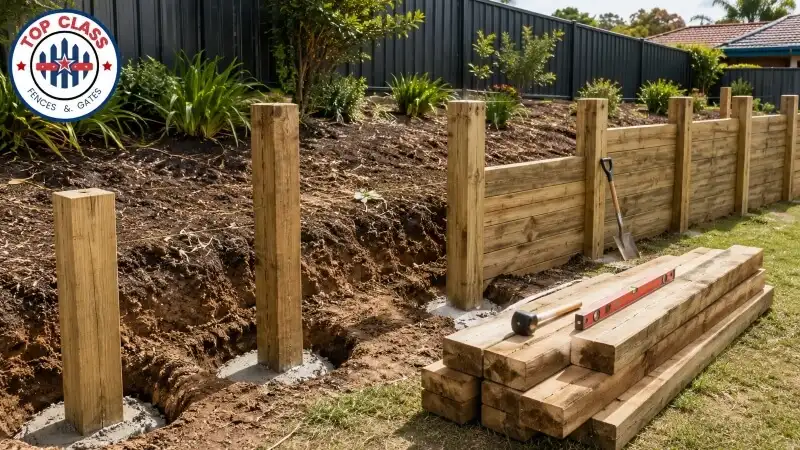
Non-negotiable for both: drainage. Every retaining wall needs free-draining gravel backfill, a slotted agricultural pipe at the base falling to a discharge point, and ideally geotextile fabric between gravel and soil. Hydrostatic pressure from waterlogged backfill is the number one killer of retaining walls in Australia — it bows concrete walls and rots timber ones. Skipping the ag pipe to save $100 is the most expensive shortcut in landscaping.
Council Approval and Engineering: Don’t Skip This Section
Across most of Australia, retaining walls under 1 metre that aren’t supporting a surcharge (driveway, structure, or another wall) generally don’t require building approval — but the threshold varies by state and council, and in some jurisdictions it’s as low as 600mm. Above the threshold, you’ll need engineering drawings and certification regardless of material.
Two practical implications:
- If your wall needs engineering anyway, concrete sleepers with steel posts are usually easier to certify — and often what the engineer specifies for taller walls.
- Walls near boundaries, easements or stormwater infrastructure can trigger approval requirements even below 1 metre. A quick call to your local council before ordering materials can save an expensive demolition order later.
This applies equally to residential landscaping and commercial or developer projects, where non-compliant retaining walls routinely hold up settlement and certification.
Beyond Walls: Sleeper Fences and Under-Fence Plinths
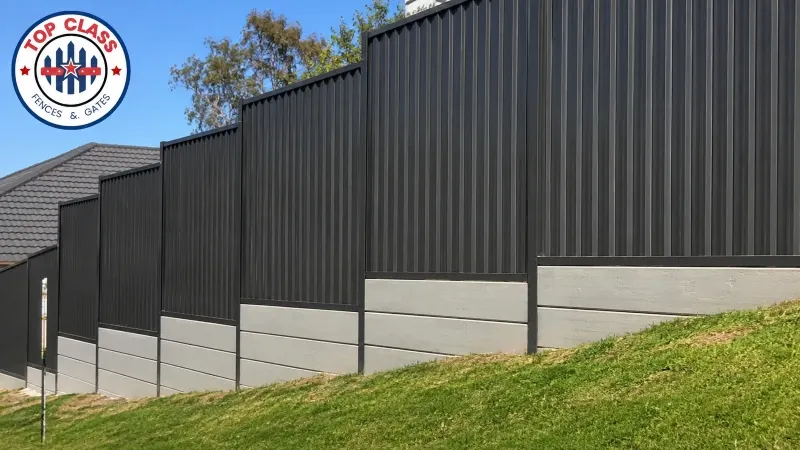
Sleepers aren’t only for retaining. A concrete sleeper fence — more precisely, concrete sleepers used as under-fence plinths or full panel infill between steel posts — has become a popular way to combine low retaining (one or two courses) with fencing above, neatly handling sloping boundaries in a single structure. A timber sleeper fence achieves the same on a budget, though the in-ground timber components inherit all the usual decay considerations.
If your boundary needs to retain even 200–400mm of soil difference between neighbours, a sleeper plinth under a standard Colorbond fence is dramatically more durable than letting fence palings sit in soil.
Which Should You Choose? A Practical Decision Framework
| Your Situation | Best Choice |
|---|---|
| Wall under 1m, no surcharge, tight budget | Timber |
| DIY build with hand tools | Timber |
| Natural look is the priority | Timber (or woodgrain concrete) |
| Short-term property (selling within ~5 years) | Timber |
| Wall over 1m or engineered | Concrete |
| Supporting a driveway, pool, shed or building | Concrete |
| Termite, bushfire or high-rainfall zone | Concrete |
| Investment property / build-once-maintain-never | Concrete |
| Developer or commercial whole-of-life costing | Concrete |
Honest middle ground: plenty of properties use both. Concrete for the big structural wall holding up the driveway; timber for the raised veggie beds and low garden terracing. Matching the material to each wall’s job — rather than picking one religion for the whole block — usually produces the best result for the money.
Frequently Asked Questions
Q. Are concrete sleepers stronger than timber sleepers?
Ans. Yes. Steel-reinforced concrete sleepers have substantially higher load capacity and don’t weaken over time, which is why engineers specify them for most walls above 1 metre or walls carrying surcharge loads.
Q. How long do concrete sleepers last compared to timber?
Ans. Concrete sleepers are typically rated at 50+ years with no maintenance. H4 treated pine generally manages 15–20 years and hardwood 20–25 years, with drainage quality being the biggest variable.
Q. Can I build a concrete sleeper retaining wall myself?
Ans. A low wall, yes — if you can set steel posts accurately and safely handle 75–85kg panels with a helper. Anything over three or four courses, or any wall requiring engineering, is best left to professionals.
Q. Do I need council approval for a sleeper retaining wall?
Ans. Usually not for walls under 1 metre with no surcharge, but thresholds vary by state and council — some require approval from 600mm. Always confirm with your local council before building, especially near boundaries.
Q. Are recycled railway sleepers safe for vegetable gardens?
Ans. Genuine old railway sleepers were often treated with creosote, which can leach into soil. For edible gardens, use new H4 treated pine rated for garden use, hardwood, or line the bed — or use concrete sleepers, which leach nothing.
Q. Can concrete sleepers look like timber?
Ans Yes — woodgrain-finish concrete sleepers are cast from real timber moulds and come in a range of stains. From a few metres away, most people can’t pick the difference.
Q. What’s cheaper overall: timber or concrete retaining walls?
Ans. Timber is cheaper upfront; concrete is almost always cheaper over 30–50 years once replacement and maintenance are factored in. The right answer depends on how long you plan to own the wall.
The Verdict
Timber retaining walls earn their place on charm, cost and DIY accessibility — they’re the right tool for low garden walls and budget builds, provided you respect the treatment class and the drainage. Concrete sleeper retaining walls cost more on day one and pay it back for the next five decades in zero maintenance, superior strength and total immunity to rot, termites and fire.
If you’re still unsure, price both options for your specific wall height and length — browse timber sleepers and concrete sleepers to compare like for like — then divide each by its realistic lifespan. The numbers usually make the decision for you.
Related guides
Building with timber? See the best timber for fencing and timber fencing costs.